
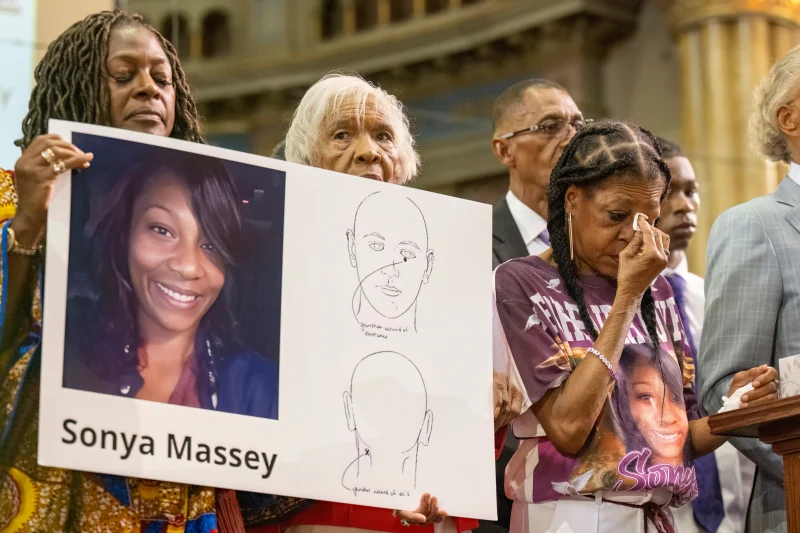
Peoria, Illinois (October 2025) — The murder trial of Illinois sheriff’s deputy Sean Grayson began this week, drawing national attention to the killing of Sonya Massey, a 36-year-old Black woman who called 911 for help at her Springfield home in 2024 but ended up being fatally shot by the responding officer.
Prosecutor: Deputy Ignored Training and Acted Out of Anger
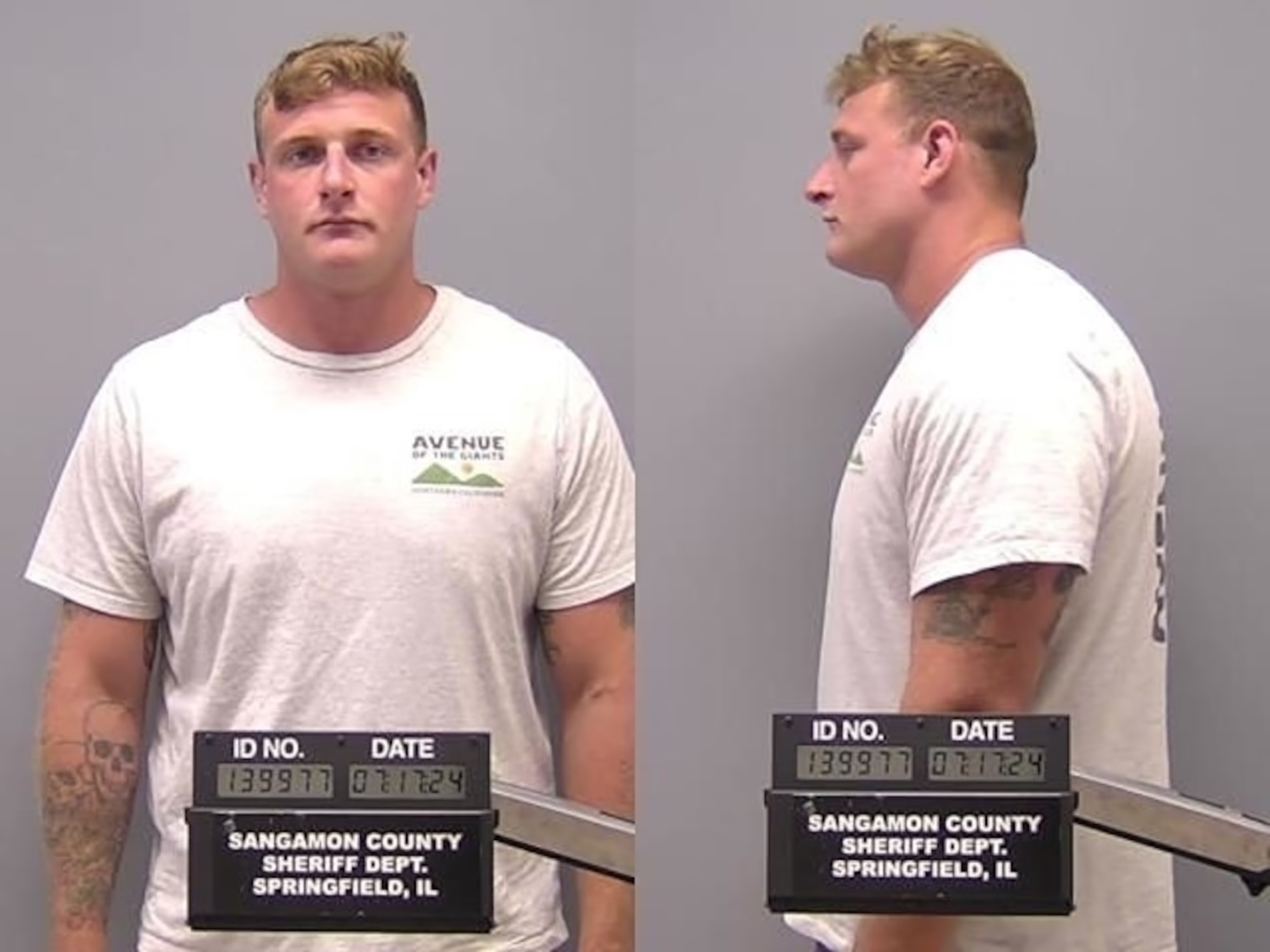
During opening statements, Sangamon County State’s Attorney John Milhiser told jurors that Grayson, who is white, “ignored his training and policing principles” when he opened fire on Massey, who posed no threat at the time.
“She’s kind, polite, and clearly calling for help,” Milhiser said. “You will see what happens when the defendant loses his temper at a woman in her own kitchen — and kills her without justification.”
Grayson faces three counts of first-degree murder for the July 6, 2024, shooting. Prosecutors allege that the confrontation began when Massey removed a pot of hot water from her stove.
The jury was shown unedited body-camera footage, causing several jurors to cover their mouths in shock. Massey’s mother, Donna Massey, left the courtroom in tears as the disturbing video played.
Defense: ‘A Tragedy, But Not a Crime’
Grayson’s attorney, Daniel Fultz, argued that his client’s use of force was reasonable under the circumstances, saying the deputy reacted when Massey allegedly raised the pot above her head.
“Deputy Grayson repeatedly ordered Ms. Massey to put the pot down,” Fultz told the court. “This was a tragedy — but not a crime. The evidence will show he made a split-second decision no police officer wants to make.”
Grayson has pleaded not guilty. If convicted, he faces 45 years to life in prison.
Body-Cam Footage Reveals the Fatal Moments
According to prosecutors, Grayson and another deputy, Dawson Farley, had responded to Massey’s 911 call about a suspected prowler. After confirming no suspicious activity, Grayson noticed the pot on the stove and instructed her to remove it.
Footage shows the two briefly laughing and talking casually, until Massey reportedly said, “I rebuke you in the name of Jesus.” Grayson later told investigators he believed the phrase was a threat to his life. He yelled for her to drop the pot before firing three shots, one striking Massey below the eye.
Partner Testifies Massey Posed No Threat
Deputy Farley, who was present during the incident, testified that Massey never behaved aggressively.
“She never said or did anything that made me think she was dangerous,” Farley told jurors. “It was my partner’s reaction — not hers — that made me alert.”
Under questioning, Farley admitted that his initial report claimed he feared Massey might throw the hot water, but he later amended his statement after Grayson was indicted. He clarified that Massey had actually been holding an oven mitt, not a pot, chest-high at the time of the shooting.
Farley, who was on a probationary period at the department, said he was advised by his union representative to avoid further contact with state investigators.
Crime Scene Questions and Evidence Delays
During testimony, Illinois State Police Lt. Eric Weston confirmed that he recovered two shell casings from Grayson’s 9mm pistol on the day of the shooting but didn’t find a third casing until days later.
Defense attorney Mark Wykoff criticized Weston for failing to collect the pot — the alleged weapon — until two weeks after the shooting.
“You knew an hour after the incident that the pot might be evidence,” Wykoff said. “Yet it sat untouched for days. Why wasn’t it collected sooner?”
Broader Impact: Calls for Police Reform and Transparency
The Sonya Massey shooting has once again sparked nationwide outrage and renewed debate over police shootings of Black Americans, particularly those who call 911 for help. The case has already led to new Illinois laws requiring deeper background checks and transparency for law enforcement candidates.
Civil rights leader Rev. Al Sharpton joined Massey’s family at a Chicago press conference, demanding accountability and reform. “Sonya Massey called for protection — not a death sentence,” Sharpton said.
Since its inception, the case has symbolized the fragile trust between communities and law enforcement. Activists say the trial could set an important precedent for accountability in police-involved shootings.
A Case That Tests Trust in Law Enforcement
As the trial continues at the Peoria County Courthouse, legal experts say jurors will be asked to decide whether Grayson’s actions were rooted in fear or bias — and whether deadly force was truly justified.
For many, the Sonya Massey case highlights the urgent need for better de-escalation training, mental health crisis response, and cultural sensitivity within U.S. policing.
If convicted, Grayson could face decades behind bars, but for Massey’s family, the outcome is about more than punishment. “We just want justice and change,” her mother said outside the courthouse.
The trial is expected to continue through next week, with additional testimony from investigators, forensic experts, and Springfield police officials.